Monday, November 18, 2013

One Libyan intelligence official killed, other kidnapped

General Yusuf al-Atrash, intelligence chief for Libya’s western city of al-Ujailat has been killed, sources told Al Arabiya News Channel late Sunday.
No-one has yet claimed responsibility for his death.
Meanwhile, Libya’s deputy intelligence chief Mustafa Nuh was also abducted in Tripoli, a security official told Agence France-Presse
Tensions ran high in the capital following deadly violence over the weekend.
“The vice president of intelligence was abducted shortly after his arrival in Tripoli from a trip abroad,” the official, who wished not to be named, told AFP.
Former rebel commander Ala Abu Hafess told the channel he was in a car with Nuh when armed men ambushed them as they were leaving the airport.
Libya’s weak central government has struggled to rein in former rebel brigades that helped end former leader Muammar Qaddafi’s 40-year rule but have since grown into increasingly threatening militias.
In October, Libyan Prime Minister Ali Zeidan was abducted for several hours by gunmen before being released unharmed.
A security chief claimed responsibility for the abduction and said he was “proud” of it.
Nuh’s and Atrash’s targeting came amid high tension in Tripoli where more than 40 people were killed and hundreds wounded when city residents rebelled against a militia.
The violence erupted on Friday when protesters, urged by local official to demonstrate peacefully against unruly militias, marched on the headquarters of a group from Misrata and were shot at from inside.

Top Syrian rebel commander dies

A top Syrian opposition commander has died from wounds suffered in an air raid on the city of Aleppo, rebel sources said on Monday.
The death of Abdelqader Saleh, head of the Islamist al-Tawhid Brigades, has dealt a blow to the armed opposition battling against President Bashar al-Assad’s forces.
“We declare the martyrdom of Abdelqader Saleh,” a statement by Tawhid said, according to Reuters news agency.
Saleh was wounded on Thursday after Assad’s forces raided a Tawhid meeting and killed another commander on the spot, opposition sources said.
He was to a Turkish hospital, where he later died.
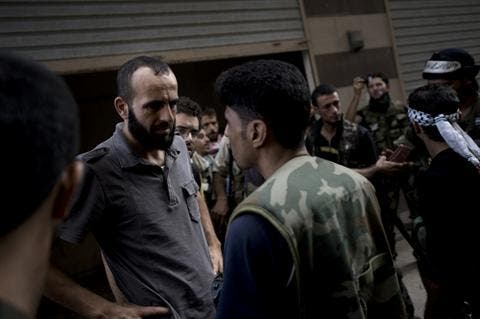
Abdelqader pictured in Aleppo last year. (File photo: AFP)
In an interview with the Opposition Orient Television from a battlefield in eastern Aleppo last week, Saleh said: “We will not let Iran and Hezbollah advance except on our dead bodies,” in reference to Assad’s forces being backed by Shiite militia from Iran and the Lebanese party Hezbollah.
Saleh, known by the nom de guerre Hajji Mareh, was a merchant from the town of Mareh in the countryside north of Aleppo.
As a former army conscript, he was known to have organized rebel brigades in the region under the Tawhid banner.
Tawhid issued a statement last week, along with other Islamist formations that included al-Nusra Front, an al-Qaeda affiliate, declaring an emergency and summoning all fighters to head to the fronts, according to Reuters.
Fighting is still raging in central parts of Syria, with reports that least 31 troops, among them four officers, were killed in a bomb attack on an army base near Damascus on Sunday.
“Three generals and a brigadier-general were among 31 troops killed in a bomb attack that caused a building in the army transport base in Harasta to collapse,” Syrian Observatory for Human Rights director Rami Abdel Rahman told Agence France-Presse.
“The timing of the attack is significant,” as it comes amid a major regime offensive on rebel positions all around Damascus, Abdel Rahman said.
(With Reuters and AFP)

Syrian delegation holds talks in Moscow on peace conference

A Syrian government delegation met Russian officials on Monday to discuss plans for an international peace conference on the conflict in the Middle East nation.
The United States, Russia and the United Nations are trying to convene the conference in Geneva to try to end the civil war in the Middle Eastern nation. Interfax news agency said a senior Iranian official was also due in Moscow for talks on Syria.
The meetings follow a telephone call on Thursday between President Vladimir Putin and Syrian President Bashar al-Assad which the Kremlin said was their first since Putin returned to the Russian presidency in 2012.
Russia has been Assad's most powerful backer during the conflict, sending arms and blocking Western efforts to condemn or pressure Assad.
The Syrian delegation, led by Deputy Foreign Minister Faisal Mekdad, entered the Foreign Ministry building in Moscow, where Russian news agencies reported they were to meet Deputy Foreign Ministers Mikhail Bogdanov and Gennady Gatilov.
A Russian diplomatic source said the Syrians might meet Foreign Minister Sergei Lavrov on Tuesday.

Syrian delegation holds talks in Moscow on peace conference

A Syrian government delegation met Russian officials on Monday to discuss plans for an international peace conference on the conflict in the Middle East nation.
The United States, Russia and the United Nations are trying to convene the conference in Geneva to try to end the civil war in the Middle Eastern nation. Interfax news agency said a senior Iranian official was also due in Moscow for talks on Syria.
The meetings follow a telephone call on Thursday between President Vladimir Putin and Syrian President Bashar al-Assad which the Kremlin said was their first since Putin returned to the Russian presidency in 2012.
Russia has been Assad's most powerful backer during the conflict, sending arms and blocking Western efforts to condemn or pressure Assad.
The Syrian delegation, led by Deputy Foreign Minister Faisal Mekdad, entered the Foreign Ministry building in Moscow, where Russian news agencies reported they were to meet Deputy Foreign Ministers Mikhail Bogdanov and Gennady Gatilov.
A Russian diplomatic source said the Syrians might meet Foreign Minister Sergei Lavrov on Tuesday.

Egypt constitution body finalises judicial articles

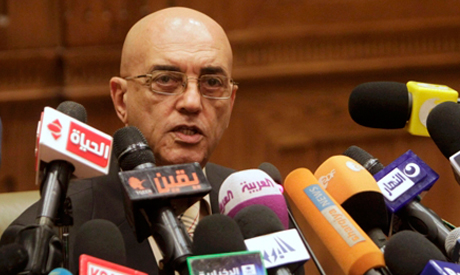
salmawi

Mohamed Salmawy, spokesman for the 50-member committee tasked with writing the final draft of Egypt's new constitution, announced on Monday that the committee has finished voting on articles related to judicial authority.

He added that the committee is expected to finish its work by the end of November. According to Salmawy, the only articles that remain for vote are those regarding the military, a transitional article on the upcoming parliamentary elections, and the constitution's preamble.
Among the most controversial army-related articles in the constitution is the one concerning military trials of civilians. 
Article 198 in the suspended 2012 constitution states that civilians may not be tried before military courts, except for crimes that "harm the armed forces" and are specified by law.
The article has sparked public debate, as rights activists campaign to amend the article to completely prohibit military trials for civilians.
There have been several suggestions to amend the controversial article so that the new draft allows military trials only for crimes that "represent a direct assault on the armed forces." 
Egypt's 2012 constitution, drafted by an Islamist-dominated constituent assembly, was suspended pending amendment following the ouster of former Islamist president Mohamed Morsi in July.
Once an amended draft is finalised, the constitutional committee will refer the charter to Interim President Adly Mansour before it is put up for national referendum. Parliamentary, and then presidential, elections will follow.

EU’s Ashton sounds optimism on reconciliation potential in Egypt

Catherine Ashton said on Monday that the situation is changing in Egypt after the lifting of the state of emergency last week.

"We have seen some interesting developments in the country. We have seen the state of emergency changing," said Ashton, in a statement published by the Delegation of European Union to Egypt, adding that she is hoping to receive the deputy prime minister soon."We have seen of course trials beginning and we have seen the potential perhaps for some form of reconciliation," said the EU's foreign policy chief.
She added that an EU mission has just returned from Cairo and that she is "looking forward today to catching up with them."
"But we continue to stay very close to Egypt and to try and support the people of Egypt through this at times quite difficult transition," she added.
However, Ashton also condemned continued violence.
The EU diplomat has repeatedly urged Egypt to adopt an inclusive democratic process that engages all factions.
Ashton has voiced alarm over the use of violence against Morsi supporters and a deepening polarisation since his exit, but has also condemned acts of violence against the authorities by Morsi supporters.
Ashton visited Egypt in October and met with several political groups, including the Muslim Brotherhood, armed forces chief Abdel-Fattah El-Sisi, and President Adly Mansour.
Analysts have interpreted Ashton's three-day visit to Cairo as a renewed attempt to broach a settlement between the transitional.
On Saturday, the pro-Morsi National Alliance to Support Legitimacy called for a national dialogue as a way out of the country's political strife, and in respect for "political plurality."
A Muslim Brotherhood source speaking on condition of anonymity told Ahram Online that the "national dialogue" proposed by group was a result of "external pressure exerted on the group and their allies" to push "for integration into the current political scene."
Minister of Social Solidarity Ahmed El-Borai stated earlier Sunday that the Egyptian government could agree to reconciliation with the Muslim Brotherhood if it accepts the transition roadmap as a starting point.

Egypt transportation minister blames 'human error' for Giza train crash

Hours after the collision that killed 27 Egyptians in a train crash south of the capital, Egypt's prime minister and transportation minister have distanced themselves from the accident, dubbing it a "human error."

Meanwhile, Transportation Minister Ibrahim El-Dmeeri expressed cautious regret over the mistake that could lead to his resignation.In a press conference on Monday, Prime Minister Hazem El-Beblawi stated that this is not the first of such "unfortunate" accidents to occur.
Almost one year ago to the day, 51 children were killed when a train crashed into their school bus in Assuit. Both the transport minister and the railway authority head were forced to resign as a result of that accident, which was blamed on a train signal operator who fell asleep on the job.
Beblawi added that an investigation was underway to determine who should be held accountable for Monday's crash.
Twenty seven people were killed early Monday when a cargo train ploughed into a truck and a minibus at a railway crossing near Dahshour in Giza governorate, 35 km south of Cairo. Another 34 people were injured in the accident, some of them in critical condition.
Local police chief Kamal El-Dali told state television that the minibus was carrying guests returning home from a wedding.
"This accident is one of many accidents that happen every day at the train crossings," El-Dmeeri said.
The Egyptian railway system is infamous for its poor safety record and frequent accidents. The service is crumbling from outdated and poorly maintained equipment. In Egypt's deadliest railway tragedy, the bodies of more than 360 passengers were recovered from a train after a fire in 2002.
Successive governments have formed fact-finding commissions to investigate these accidents, but they did little to shed light on the details and less still to bring about accountability.
"The state has put out a program to develop and secure the crossings, which will be completed by June of next year," El-Dmeeri said, adding that a bridge will be constructed at the Dahshour accident site so that cars do not have to cross the tracks.
The transportation minister said that only 891 train crossings in Egypt are official, whereas another 4500 are make-shift crossings established by local residents.
El-Dmeeri confirmed an earlier report by the Egyptian Railways Authority, which asserted that the Dahshour crossing was closed off by chains before the accident and that the warning lights were working properly.
"Vehicles ignored warning lights and chains blocking entry, and tried to drive through the crossing," the report stated.
However, two watchmen at the crossing told Al-Ahram's Arabic news website that the manual alarm bells and warning lights for approaching trains were out of service.
Monday's accident comes as train services across the country resume operations following a three-month halt due to the overthrow of president Mohamed Morsi in July.
"I just wish that people would abide by the traffic guidelines, because we all suffered when the trains stopped," El-Dmeeri said.
"Civilians, drivers and everybody in this country should cooperate with us to keep this service going," added the one-time Mubarak-era minister who oversaw the minstry during the 2002 disaster.